
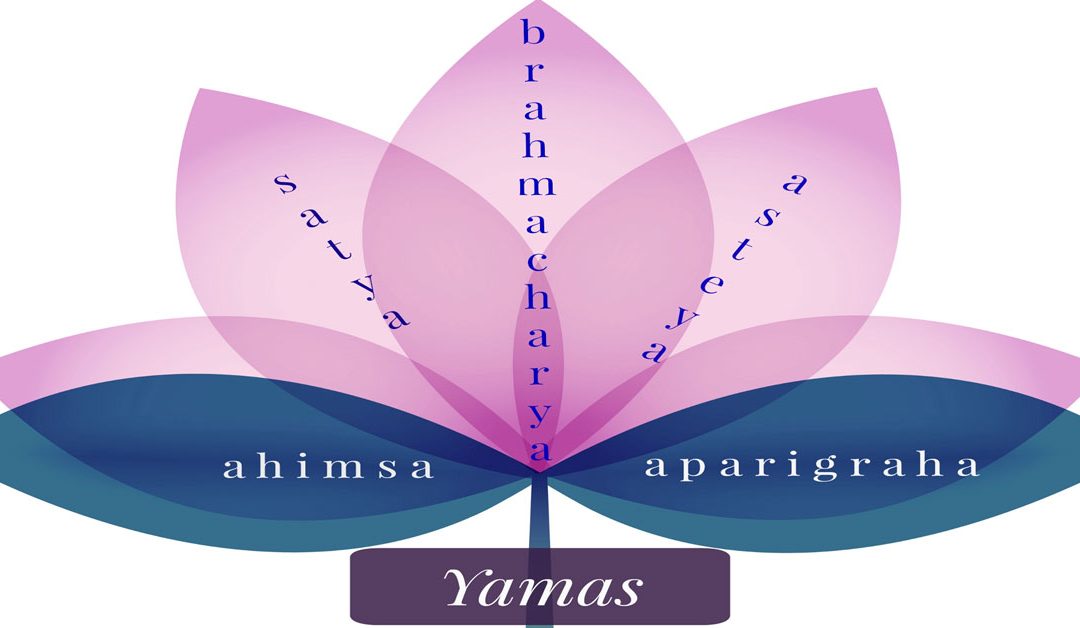
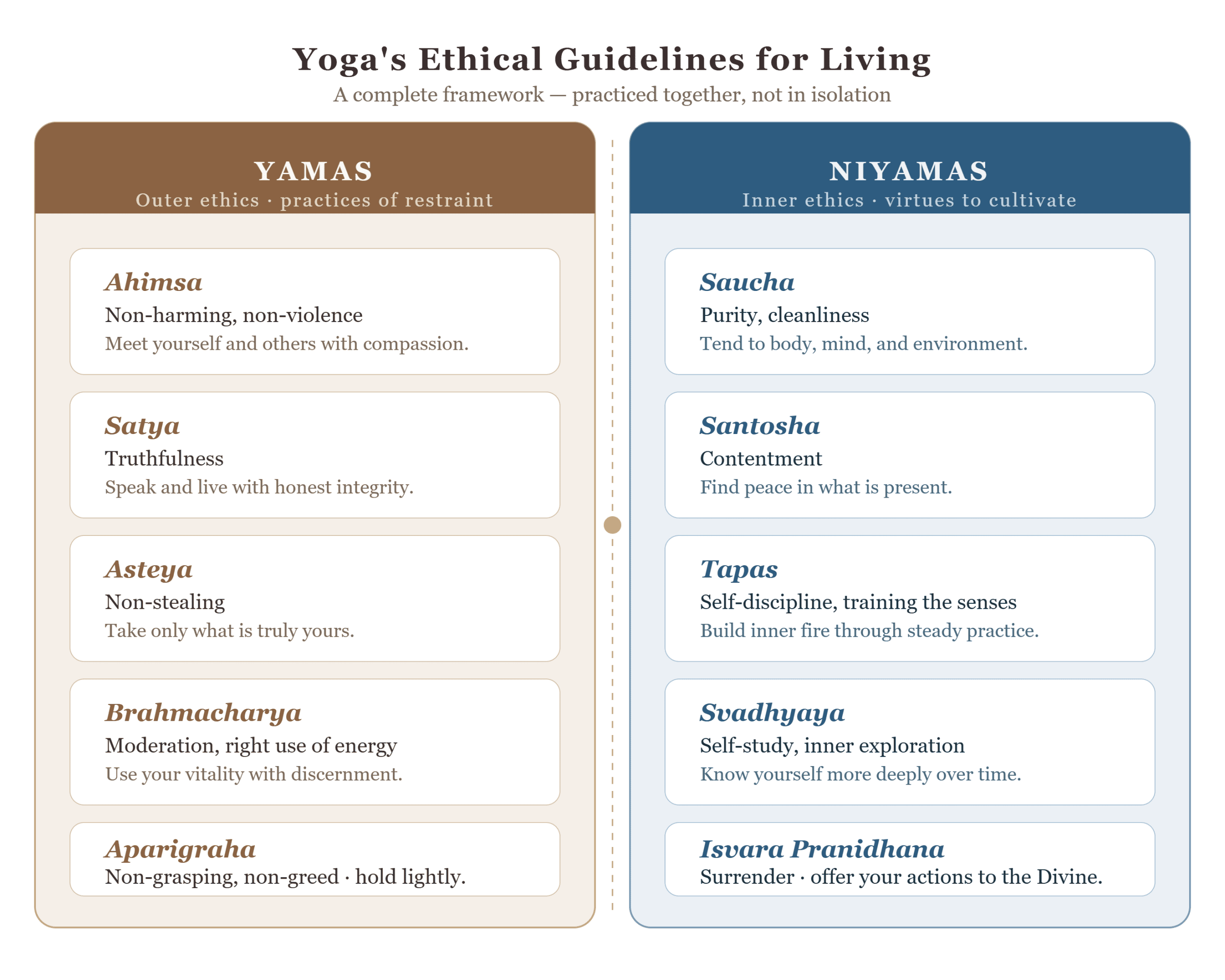
A gentle reminder before we begin: over the past several months, I have been sharing a series of reflections on yoga’s ethical guidelines for living, a set of ancient principles called the yamas and niyamas. These are not poses or postures. They are a way of moving through your life. The yamas are the outer ethical practices – things to move away from. The niyamas are the inner virtues – things to actively cultivate. Together, they form a complete map for living with greater integrity, ease, and presence. We have already explored ahimsa (non-harming) and satya (truthfulness). Today, we complete the yamas with three more practices that, in my experience, speak directly to the struggles of modern life.
Asteya: The Practice of Non-Stealing
There is a scene at the heart of the film “Mank” (the story of Hollywood screenwriter Herman J. Mankiewicz) that has stayed with me. He wrote what many consider to be among the greatest screenplays in cinema history, only to have the credit taken from him entirely. The work was his. The recognition went elsewhere.
Most of us will never face that particular form of theft. But asteya, the third yama, asks us to look at something far more subtle and far more common: the many quiet ways we take what is not ours to take.
Accepting praise for another’s idea in a meeting. Consuming more than we need while others go without. Stealing from our own future self by spending our energy reserves down to nothing, day after day, with no replenishment.
Asteya calls us to become aware. Not with guilt, but with honesty. The ancient sage Sri Swami Satchidananda described the first three yamas as simple in their expectations, even “elementary,” but said they must be remembered as “elephantary” (a nod to the long memory of elephants). Perfecting these practices is not easy, and they must not be forgotten.
The deeper teaching of asteya is this: when we trust in the abundance of the universe, we lose the impulse to grasp for more than what is ours. Harmony replaces competition. Trust replaces scarcity. The perception of lack is largely a creation of our culture, and it is one we can gently, consciously begin to release.
A question to sit with: Where in my life am I taking more than I need: of time, of energy, of praise, of resources? And where might I offer more generously instead?
Brahmacharya: The Practice of Moderation
I think of a woman I worked with (a high achiever in every sense of the word) who prided herself on the intensity of her workouts as much as the intensity of her work. She wore her busyness like a badge of honor. Then an injury stopped her. A sprained ankle that healed, but not completely. A weakness that remained.
In the slowing down that followed, something unexpected happened. She and her workout partner restructured their schedule – adding a rest day, trading one intense session for yoga. Within a month, both women felt they were coping better with stress. And her ankle, which had plateaued in its recovery, began to strengthen again.
The body, it turns out, had been trying to tell her something all along.
Brahmacharya is often translated in ancient texts as celibacy, and that is one dimension of its meaning. But in the context of daily modern life, it speaks to something broader and more immediate: the right use of energy. Moderation. Boundaries with your own time and vitality.
In both Ayurveda and the yogic tradition, this yama is connected to the concept of ojas (a subtle life-force energy that governs immunity, resilience, and luminosity). Ojas is depleted by overextension: too much stimulation, too little rest, an inability to say no. It is replenished by practices of presence, nourishment, and stillness.
BKS Iyengar, one of the great yoga teachers of the twentieth century, defined brahmacharya as “continence or self-restraint of the body, mind and speech.” What would it mean for you to practice that today? Not as deprivation, but as discernment. Not as restriction, but as an act of devotion to your own wholeness.
A question to sit with: Where in my life am I running on empty? What is one boundary (with technology, with commitments, with my own inner critic) that would restore some of that lost vitality?
Aparigraha: The Practice of Non-Grasping
During the early months of the pandemic, many were hoarding toilet paper. Stores had run out. Shelves were bare. There was a collective panic in the air. A fear that there would not be enough.
I made a quiet decision not to join in the rush. I let it go. I trusted.
A week later, I walked into Costco having nearly forgotten about it entirely. There on the pallet was a fresh shipment, arrived just an hour before. I took the one package I was allowed. I thanked the clerk. And I walked out with exactly what I needed… nothing more, nothing less.
This is aparigraha. The last of the five yamas. Freedom from grasping.
In Sanskrit, aparigraha means non-hoarding, non-coveting, non-greed. It is the practice of releasing our attachment to outcomes, to possessions, to the belief that accumulating more will finally make us feel safe. Our possessions cannot give us happiness, though many of us spend years (and significant resources) testing that theory. The feeling created by a new acquisition is real, but it is momentary. And in the space that follows, there is often an emptiness that no object can fill.
The great wisdom teachers across traditions (from Jesus to Thoreau to Gandhi) have all pointed toward this same truth: the clinging itself is the source of suffering, not the lack.
Aparigraha also invites us to do what I call an inventory of the heart. The wounded heart is often the most prolific hoarder of all – holding tightly to old injuries, unresolved anger, accumulated grief. These emotional attachments are as real and as limiting as any physical possession. What hurts, what fears, what jealousies remain lodged in your chest, quietly narrowing the space available for joy?
We arrive into this life with nothing and we leave with nothing. In between, the invitation is to use what we need, share what we have, and trust that what is meant for us will find its way.
A question to sit with: What am I holding onto (in my home, in my schedule, in my heart) that no longer serves me? What might become possible if I released it?
The Yamas as a Complete Practice
With aparigraha, we complete the five yamas – yoga’s outer ethical guidelines for living. Taken together, they form a coherent and quietly revolutionary way of moving through the world:
Ahimsa: meet yourself and others with non-harming
Satya: speak and live with truthfulness
Asteya: take only what is yours
Brahmacharya: use your energy with discernment
Aparigraha: hold everything lightly
None of these practices ask for perfection. They ask for awareness: a returning, again and again, to a way of being that honors your wholeness and the wholeness of the world around you.
Next month, we turn inward. The niyamas (yoga’s inner ethical practices) are where the real alchemy begins. I look forward to sharing them with you.
With ancient wisdom for your modern life,
Judith Pentz, MD


