

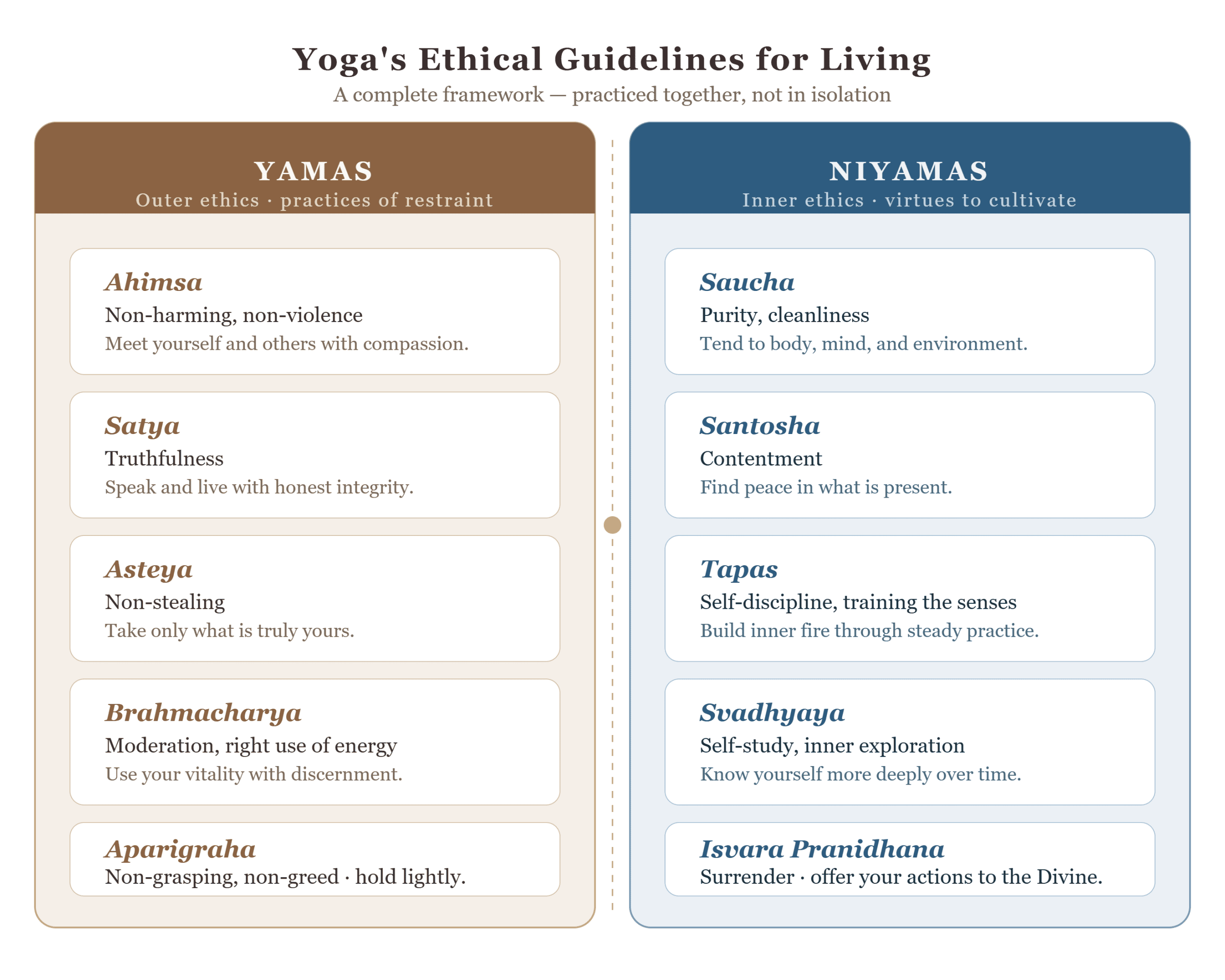
A gentle reminder before we begin: over the past several months, I have been sharing a series of reflections on yoga’s ethical guidelines for living, a set of ancient principles called the yamas and niyamas. These are not poses or postures. They are a way of moving through your life. The yamas are the outer ethical practices – things to move away from. The niyamas are the inner virtues – things to actively cultivate. Together, they form a complete map for living with greater integrity, ease, and presence. We have already explored ahimsa (non-harming) and satya (truthfulness). Today, we complete the yamas with three more practices that, in my experience, speak directly to the struggles of modern life.
Saucha: The Practice of Purity
Think of the last time you prepared your home for someone you love — a guest, a celebration, a special gathering. You cleared away the clutter. You brought in fresh flowers. You set the table with care. You chose what would nourish the space and what would not belong there.
That act of preparation is saucha. Purity. Cleanliness. And it extends far beyond our physical surroundings.
Saucha is the first niyama, and it encompasses our outer and inner worlds equally. Outer saucha is about the body, the food we choose, the environment we inhabit. Inner saucha — the more subtle and perhaps more challenging practice — is about the quality of what we allow into our minds.
I think of this often in the context of modern life. The murkiness that can accumulate in our thinking — the fear-based news, the comparison that scrolls through a phone screen, the stories we tell ourselves about what we lack — is as real a form of impurity as physical toxins in the body. Saucha asks us to become discerning about what we consume: in food, in media, in conversation, in the quiet moments of our own interior lives.
What would it look like to prepare yourself each day the way you would prepare a sacred space? A morning practice. Nourishing food. A few moments of stillness before the world rushes in. These are not luxuries. They are acts of inner housekeeping that make everything else more possible.
A question to sit with: What am I allowing into my mind and body today that muddies rather than clarifies? What one choice could bring more purity into this day?
Santosha: The Practice of Contentment
A few years ago, I brought a goldendoodle puppy named Sage into my life. I gave her that name knowing, on some level, that she would be one of my teachers.
She did not disappoint. In her first weeks with me, she tested every corner of my patience — her needle-sharp teeth finding my hands with uncanny precision, her barking announcing the day before I was ready for it. My morning practice, so carefully built over years, required reconstruction around the reality of a creature who needed me on her schedule, not mine.
And yet. In the slowing down, in the finding of a new rhythm, something softened. I committed to enjoying the moments of sweetness — the unconditional presence she offered, the laughter she brought into rooms — and to letting go of the struggle rather than feeding it. That practice of choosing to be content with where we were, rather than where I thought we should be, is the heart of santosha.
Contentment, the yoga teacher Rama Jyoti Vernon wrote, is “a state of knowing that everything we thought we needed or wanted is already within us.” This is not the contentment of complacency — it is not giving up on growth or desire. It is the practice of meeting this moment, this day, this season of life with a quality of fullness rather than lack. Of saying, even imperfectly, even while still reaching for more: what I have is enough. What I am is enough. Right now.
Mr. Iyengar described it beautifully: contentment arrives when the flame of the spirit does not waver in the wind of desire. The winds of desire are different for each of us. The path to stillness is the same.
A question to sit with: Where in my life am I withholding contentment from myself until some future condition is met? What would it feel like to say, right now, “what I have is enough”?
Tapas: The Practice of Sacred Fire
To write my first book, Cleanse Your Body, Reveal Your Soul, I needed something I could not manufacture from the outside. No deadline imposed it. No publisher required it. The drive to complete it — through rewrites, through rejections, through the long months when it felt like it might never find its way into the world — came from somewhere deeper.
That inner fire is tapas.
Translated from Sanskrit as the “application of heat,” tapas is the third niyama, the practice of self-discipline as a spiritual act. It is not discipline as punishment or rigid self-denial — it is the willingness to remain present with discomfort, to stay steady when the easier path is to step away. In Ayurveda, this inner fire is called agni — the digestive fire that transforms not only our food but our emotions, our grief, our unfinished stories.
The yoga teacher David Frawley describes tapas as the process of mastering our own faculties and energies. Rama Jyoti Vernon calls it learning to endure hardship “by not seeking comfort but finding comfort wherever we are” — to accept all situations with grace and ease, not because we have become indifferent to them, but because we have found something inside that does not require conditions to remain steady.
October, as the days shorten and the light shifts, is a beautiful time to tend this inner fire. Many traditions honor the light precisely now — when darkness gathers, we light candles. We kindle what is essential. Tapas is that kindling, practiced daily: the yoga asana held one breath longer than feels comfortable, the meditation sat through despite the restless mind, the commitment returned to after it has been dropped.
What you are willing to stay with is what transforms you.
A question to sit with: Where in my life is a steady inner fire needed most right now? What practice am I being called to stay with — even when I would rather not?
Svadhyaya: The Practice of Self-Study
My dog Sage — who has now grown from that needle-toothed puppy into a wise and devoted companion — has been one of my most honest mirrors.
In watching our relationship evolve, I have had to see myself clearly. The moments when I led with frustration rather than patience. The times I missed her cues because I was too distracted to be present. The days when she offered unconditional love and I was too busy to fully receive it. Sage does not lie. Her response to who I am at any given moment is immediate and transparent.
This is svadhyaya — self-study. The niyama of honest inner inquiry.
Iyengar described the practice of svadhyaya as reading your own book of life, at the same time that you are writing it and revising it. What a profound image. We are not fixed characters in a story already told. We are authors, mid-sentence, with the capacity to see the patterns we have been writing — and to choose differently.
Svadhyaya can take many forms: meditation, journaling, the study of sacred texts, time in nature that allows the interior voice to be heard. Chanting the yoga sutras has become one of my own most powerful forms of this practice — a daily immersion in ancient wisdom that continues to show me where I am living in alignment with my higher self, and where I am still learning.
Rumi wrote: “Don’t be satisfied with stories, how things have gone for others. Unfold your own myth.” Svadhyaya is the practice of doing exactly that — bringing enough honest, compassionate attention to your own life that you begin to understand the myth you are living, and whether it is the one you truly wish to write.
A question to sit with: What does my life, honestly observed, reveal about the patterns I am still repeating? What practice of reflection might help me see myself more clearly — and more kindly?
Isvara Pranidhana: The Practice of Surrender
I am writing this from a memory that has never left me. An afternoon in India, where I had come for an eight-day Panchakarma cleanse. The sun had returned after several days of rain. Birds were calling from a nearby tree. Below my window, the sounds of the city — honking cars, motorcycles, tuk tuks — ebbed and flowed from the corner.
A woman was hanging her laundry to dry. Another was working quietly at her computer. And I sat watching, breathing, entirely present. Not managing the moment. Not improving it. Simply receiving it.
That quality of open, non-judging presence — aware without grasping, still without being absent — is what the ancient teachers called Isvara Pranidhana. The surrender of the small self to the Divine Self within. The bow.
Isvara Pranidhana is the fifth and final niyama, and it is in many ways the one that holds all the others. You cannot fully practice saucha, santosha, tapas, or svadhyaya without arriving, eventually, at the understanding that you are not doing this alone. That something larger than your personal will is participating in your becoming. Surrender is not weakness — it is the most courageous act available to us. It is the choice to stop white-knuckling the journey and trust the river.
When Thich Nhat Hanh passed away in early 2022, I found myself returning to his teachings on presence. His capacity to embody stillness in motion — to make a simple walk an act of meditation, to meet Martin Luther King Jr. over a shared breakfast and plant seeds of peace that would grow into communities — was a living example of Isvara Pranidhana. He did not hold tightly to outcomes. He offered his practice to something greater and trusted what came.
This is the invitation at the heart of the entire yamas-and-niyamas journey. Not to be perfect. Not to complete the list. But to practice — daily, imperfectly, with growing awareness — and to offer that practice, moment by moment, to the Divine self you are becoming.
A question to sit with: Where in my life am I gripping too tightly — to an outcome, a relationship, an identity? What might become available if I chose, just for today, to bow and release?
The Complete Map
With Isvara Pranidhana, we arrive at the end of a long and beautiful journey. The yamas and niyamas, taken together, offer something rare in our culture: a complete ethical and spiritual framework for living that asks nothing of you except your honest, ongoing attention.
They are not a destination. They are a practice — a returning, again and again, to the person you are most deeply called to be. The yamas taught us how to move through the world with integrity. The niyamas have shown us how to tend the inner life that makes that outer integrity possible.
If you would like a place to bring these practices into your daily life, the 6-Week Resilience Integration Journal was created for exactly this — a gentle, structured container for the morning and evening rituals, the Ayurvedic self-care tools, and the reflective practices that support this kind of inner cultivation. It is available on Amazon and I hope it serves you well.
Thank you for walking this path alongside me. It has been a privilege to share it.
With ancient wisdom for your modern life,
Judith Pentz, MD


